Standing over your approach shot, you squint at the flagstick—Is it 145 yards? 155? Your playing partner swears it’s closer to 135. You grab your 8-iron, swing perfectly, and watch the ball sail 15 yards long. Sound familiar? For weekend golfers and casual players alike, guessing yardages is one of the biggest frustrations holding back your game. But here’s the good news: a high-quality golf rangefinder eliminates the guesswork, boosts your confidence, and helps you shave strokes off your handicap—without breaking the bank.
In 2026, golf rangefinders are more feature-packed and accessible than ever before. From budget-friendly models perfect for beginners to pro-level devices trusted by tour players, there’s a rangefinder for every golfer and every budget. This guide will break down everything you need to know about golf rangefinders: how they work, key features to look for, the difference between laser and GPS models, and why investing in one is one of the smartest moves you can make for your game.
Why Every Golfer Needs a Golf Rangefinder (Yes, Even You)
Gone are the days of relying on course markers or “guesstimating” distances. A golf rangefinder isn’t just a fancy gadget—it’s a game-changer. According to a recent survey, 90% of golfers report dramatically improved club selection confidence after just three rounds with a rangefinder. Here’s why it matters:
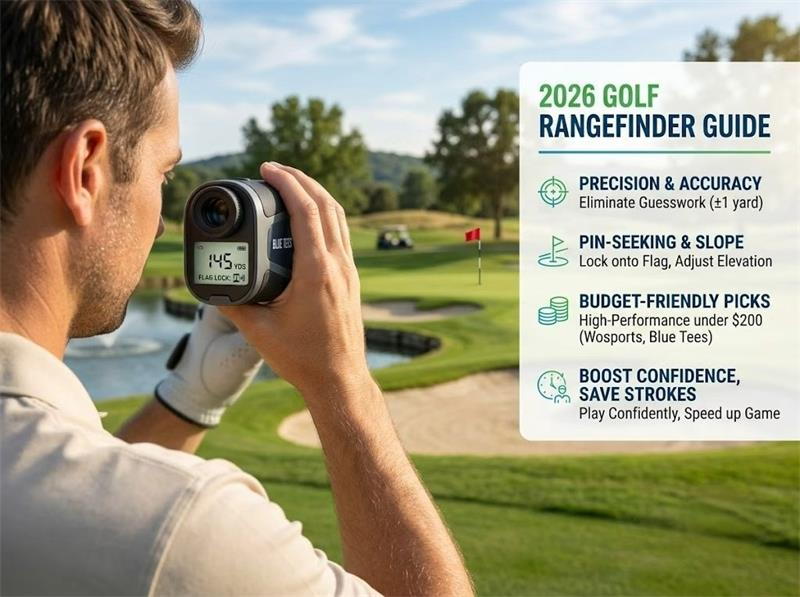
- Eliminate Guesswork: Get pinpoint accuracy (often within 1 yard) to the flagstick, hazards, bunkers, or any target on the course. No more second-guessing if you need a 7-iron or 8-iron—your rangefinder gives you the exact number.
- Boost Confidence: When you know the exact distance, you swing with more commitment. No more overthinking or doubting your club choice—just smooth, confident shots.
- Save Strokes: By choosing the right club every time, you’ll avoid over-hitting or under-hitting shots, leading to fewer bogeys and more pars (or birdies!).
- Speed Up Play: No more pacing off distances or arguing with your playing partners about yardages. A quick scan with your rangefinder gets you back to swinging faster.
And if you’re worried about tournament rules? Since 2019, the USGA and R&A updated regulations to allow rangefinders in most competitions (though tournament committees can still prohibit them). Many models even have a slope toggle that lets you turn off elevation adjustment for tournament-legal play.
Golf Rangefinder Types: Laser vs. GPS—Which Is Right for You?
Golf rangefinders come in two main types: laser and GPS. Each has its own strengths, and the best choice depends on your playing style, budget, and preferences. Let’s break down the differences:
- Laser Golf Rangefinders (Most Popular for Precision)
Laser rangefinders are the go-to choice for golfers who prioritize accuracy. They work by emitting a laser pulse to your target (like the flagstick), then calculating the distance based on how long it takes the laser to reflect back. Here’s what you need to know:
- Accuracy: The most precise option—most laser models are accurate to within 1 yard, even at distances up to 600+ yards.
- Key Features: Look for pin-seeking technology (to lock onto the flagstick and ignore background trees), slope adjustment (to account for uphill/downhill shots), and vibration feedback (to confirm you’ve locked onto the target).
- Best For: Golfers who play multiple courses, want pinpoint accuracy, and prefer a simple “point-and-shoot” experience.
- Top Picks: Bushnell Pro X3+ (pro-level, with wind and slope compensation), Blue Tees Series 4 Ultra (affordable, with flag-lock and pulse vibration), and Nikon Coolshot Stabilized (great for golfers with shaky hands).
- GPS Golf Rangefinders (Convenient for Course Mapping)
GPS rangefinders use satellite technology to provide pre-loaded course maps and distances to key points (front/back/center of the green, hazards, etc.). They don’t require you to aim at a target—just turn them on, select your course, and go.
- Convenience: No aiming needed—distances are displayed instantly as you move around the course. Many models come with 35,000+ pre-loaded courses worldwide.
- Key Features: Look for green contour maps, hole-by-hole satellite views, and smart club recommendations based on elevation and wind data.
- Best For: Golfers who play the same course regularly, prefer hands-free operation, or don’t want to aim at targets.
- Top Picks: Garmin Approach Z30 (hybrid laser/GPS), Golf GPS Range Finder App (budget-friendly phone app), and Shot Scope Pro X (customizable with shot tracking).
Key Features to Look for in a 2026 Golf Rangefinder
Not all golf rangefinders are created equal. When shopping for one, focus on these features to ensure you get the best value for your money:
- Accuracy: Look for models with ±1 yard accuracy—this is non-negotiable for serious golfers.
- Slope Adjustment: A must-have for practice rounds (it calculates adjusted distances for elevation changes). Choose a model with a slope toggle for tournament play.
- Pin-Seeking Technology: Ensures you lock onto the flagstick, not background trees or bushes. Vibration feedback confirms a locked target.
- Display: A bright, easy-to-read display (even in direct sunlight) is crucial. Look for OLED or transflective LCD screens.
- Durability: Golf courses can be tough on gear—choose a water-resistant (IPX5 or higher) and shock-resistant model to handle rain, drops, and rough handling.
- Battery Life: Rechargeable batteries are more convenient than disposable ones. Look for models that last 36+ holes on a single charge.
- Magnetic Mount: A built-in magnet lets you attach the rangefinder to your golf cart for quick access—no more fumbling in your bag.
Budget-Friendly Golf Rangefinders (Under $200) That Don’t Sacrifice Quality
You don’t need to spend $500+ on a tour-level rangefinder to improve your game. These budget-friendly models deliver 90% of the performance at 40-50% of the cost:
- Wosports L06: Best budget pick (under $100) with 6x magnification, pin-seeking, and slope adjustment. Perfect for beginners.
- Blue Tees Series 3 Max+: Under $150, with flag-lock, pulse vibration, and a compact design. Great for weekend golfers.
- Callaway Golf 300 Pro: Under $200, with 6x magnification, pin acquisition technology, and water resistance. A step up for serious beginners.
Pro Tips for Using Your Golf Rangefinder Like a Pro
Even the best rangefinder won’t help you if you don’t use it correctly. Here are a few tips to get the most out of your device:
- Practice Before You Play: Spend 5-10 minutes practicing with your rangefinder before your round to get comfortable with the controls.
- Lock Onto the Flagstick: Aim slightly below the flag (not the top) to avoid background interference. The pin-seeking feature will do the rest.
- Use Slope Wisely: On uphill shots, the adjusted distance will be longer (so use a more powerful club). On downhill shots, the adjusted distance will be shorter (use a less powerful club).
- Keep It Clean: Wipe the lens with a microfiber cloth to avoid blurry readings—dirt or smudges can affect accuracy.
Final Thoughts: Invest in Precision, Elevate Your Game
A golf rangefinder is one of the most valuable investments you can make for your golf game. It eliminates guesswork, boosts confidence, and helps you play smarter—not harder. Whether you’re a beginner looking to improve or a casual golfer wanting to have more fun on the course, there’s a rangefinder that fits your needs and budget.
In 2026, don’t let inaccurate yardages hold you back. Pick a golf rangefinder that aligns with your playing style, and watch your handicap drop, your confidence soar, and your enjoyment of the game grow. After all, golf is about precision—and a rangefinder gives you the precision you need to play your best.
Ready to find your perfect golf rangefinder? Check out our top picks for 2026, and let’s get you hitting better shots, one precise yard at a time.