Whether you’re a beginner looking to improve your swing or a low-handicap golfer searching for more distance, a golf launch monitor has become one of the most valuable training tools in modern golf.
Years ago, launch monitors were only available at professional fitting studios and indoor golf facilities. Today, compact Doppler radar technology has made accurate launch data accessible to golfers at home, on the driving range, or even in the backyard.
In this guide, we’ll explain what a golf launch monitor is, how it works, which data matters most, and how to choose the right model for your needs.
What Is a Golf Launch Monitor?
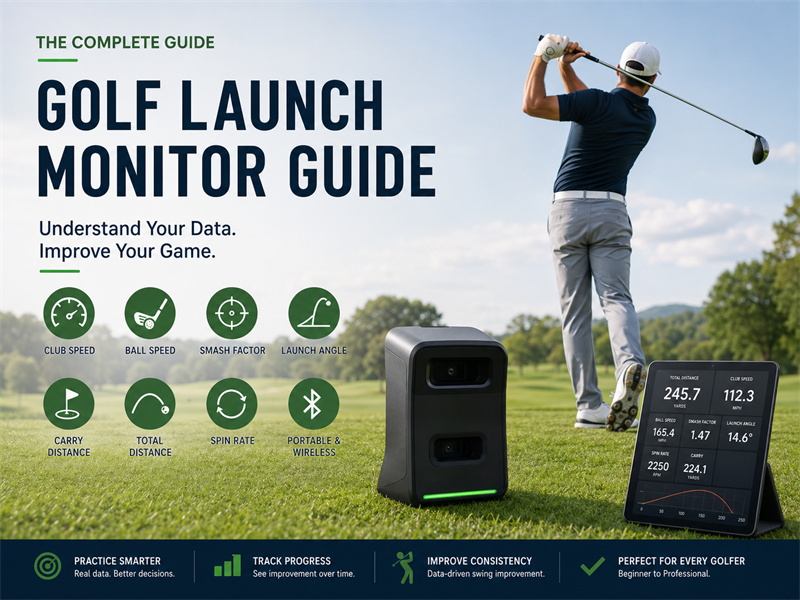
A golf launch monitor is a device that measures club and ball performance immediately after impact. Using Doppler radar or high-speed cameras, or a combination of both, it captures valuable shot data that helps golfers understand exactly what happened during each swing.
Instead of relying on feel alone, golfers can make informed adjustments based on measurable performance.
Why Every Golfer Can Benefit from a Launch Monitor
One of the biggest challenges in golf improvement is knowing whether a swing change is actually working.
A launch monitor provides instant feedback after every shot, allowing players to compare results and track progress over time.
Benefits include:
Measure club speed and ball speed accurately
Smash factor
Understand carry distance versus total distance
Improve consistency during practice
Key Launch Monitor Metrics Explained
Club Speed
Club speed measures how fast the clubhead is moving at impact. It is one of the primary factors influencing distance and is especially important for golfers working on speed training.
Ball Speed
Ball speed indicates how efficiently energy is transferred from the club to the golf ball. Higher ball speed generally results in greater distance.
Smash Factor
Smash Factor equals Ball Speed divided by Club Speed.
A higher Smash Factor often indicates more efficient contact and better energy transfer.
Carry Distance
Carry distance measures how far the ball travels before first touching the ground. This is one of the most important numbers for club selection on the course.
Total Distance
Total distance includes carry plus roll after landing. Weather and ground conditions can influence this value.
Launch Angle
Launch angle describes the initial angle of the golf ball after impact. Finding the optimal launch angle helps maximize both distance and consistency.
Spin Rate
Spin significantly affects ball flight.
Backspin helps create lift and stopping power.
Side spin influences shot curvature such as draws and fades.
Understanding spin allows golfers to improve both distance control and shot accuracy.
Doppler Radar vs Camera-Based Launch Monitors
There are two main technologies used in golf launch monitors.
Doppler Radar
Doppler radar tracks the golf ball throughout its flight and is ideal for outdoor practice.
Advantages include:
Excellent outdoor accuracy
Long-distance ball tracking
Compact and portable
Fast setup
Camera-Based Systems
Camera systems capture high-speed images at impact and often provide highly detailed club delivery data.
Advantages include:
Extremely precise impact measurements
Excellent for indoor simulator environments
Advanced fitting applications
The best choice depends on where and how you practice.
Portable Launch Monitors Are Changing Golf Practice
Today’s portable launch monitors allow golfers to practice almost anywhere.
Whether you’re warming up before a round, practicing at the driving range, or training in your garage, compact radar technology provides professional-level feedback without requiring expensive simulator installations.
Many portable devices now include Bluetooth connectivity, mobile app integration, rechargeable batteries, and lightweight designs that easily fit into a golf bag.
What to Look for When Buying a Golf Launch Monitor
Before purchasing, consider the following factors:
Accuracy
Reliable shot data is the most important feature. Look for proven measurement technology and consistent performance.
Data Metrics
Choose a model that provides the metrics most relevant to your game, such as club speed, ball speed, carry distance, launch angle, and spin.
Portability
A lightweight, rechargeable device makes practice more convenient both indoors and outdoors.
Software Compatibility
An intuitive mobile app with shot history, statistics, and firmware updates enhances the overall experience.
Free of subscribe
No subscribe fee
Battery Life
Long battery life allows extended practice sessions without interruption.
Price
Today’s market offers excellent options ranging from entry-level practice devices to professional launch monitors.
Choose a model that matches both your budget and your training goals.
Who Should Use a Golf Launch Monitor?
Launch monitors are suitable for:
Beginner golfers learning distance control
Mid-handicap players improving consistency
Competitive golfers optimizing performance
PGA professionals and coaches
Golf academies
Club fitters
Indoor golf simulator businesses
Regardless of skill level, objective data helps golfers practice more efficiently.
The Future of Golf Training
As technology continues to evolve, launch monitors are becoming smaller, smarter, and more affordable.
Artificial intelligence, cloud-based shot analysis, mobile coaching platforms, and personalized practice recommendations are making launch monitors an essential part of modern golf training.
Instead of simply hitting more golf balls, players can now practice with purpose, measure every improvement, and make better decisions based on real data.
Conclusion
A golf launch monitor is no longer a luxury reserved for professionals. It has become one of the most effective tools for golfers who want to improve faster through data-driven practice.
Whether you’re working on swing speed, distance control, or overall consistency, the right launch monitor provides immediate feedback that helps every practice session become more productive.
Investing in reliable launch monitor technology means spending less time guessing—and more time improving.