A golf swing speed meter is a useful training tool for golfers who want to understand their swing speed and improve their performance. By measuring club speed during a swing, a reliable device can help golfers track training progress, compare different clubs, and build a more consistent swing.
However, choosing the right golf swing speed meter can be difficult, especially for beginners. Many products look similar, but their measurement accuracy, response speed, display quality, detection range, and overall reliability can be very different.
In this Golf Swing Speed Meter Buying Guide, we explain what to look for, common problems to avoid, and how to choose the right swing speed measuring device for your needs.
What Is a Golf Swing Speed Meter?
A golf swing speed meter is a device designed to measure the speed of a golf club during a swing.
Depending on the technology used, a golf swing speed meter may use radar, optical sensors, or other motion-measurement technologies to detect club movement.
The measured data can help golfers understand their swing performance and monitor changes during practice.
Commonly displayed information may include:
- Club swing speed
- Swing speed in MPH or KM/H
- Training statistics
- Maximum swing speed
- Average swing speed
- Session results
For beginners and amateur golfers, the main advantage is simple: you can turn your swing into measurable data.
Instead of relying only on how a swing feels, golfers can use objective speed data to track improvement.
Why Use a Golf Swing Speed Meter?
Swing speed is an important performance indicator in golf.
In general, higher clubhead speed can create greater potential for distance. However, speed alone does not guarantee better golf. Accuracy, consistency, club selection, contact quality, and swing technique are also important.
A golf swing speed meter can be particularly useful for:
1. Beginners
New golfers often have difficulty understanding whether their swing is actually improving.
A swing speed meter provides immediate feedback and makes practice more measurable.
2. Amateur Golfers
Regular golfers can use swing speed data to monitor changes over time and compare their performance between training sessions.
3. Golf Coaches
Coaches can use swing speed measurements as part of a broader training program to evaluate player development.
4. Golf Training Facilities
Training centers can use swing speed meters to provide additional data during lessons and practice sessions.
5. Home Golf Training
Compact and portable devices can be used for indoor or backyard training where appropriate.
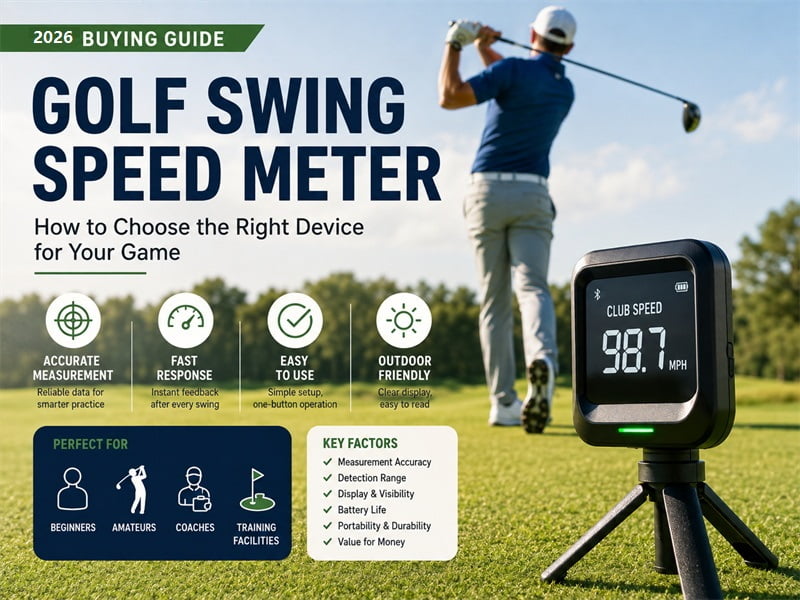
What Should You Look for in a Golf Swing Speed Meter?
Not every golf swing speed meter offers the same level of performance.
Before buying one, pay attention to the following factors.
1. Measurement Accuracy
Accuracy is one of the most important factors when choosing a golf swing speed meter.
If the device produces inconsistent results, the data becomes difficult to use for training.
For example, if a golfer makes several similar swings but the device reports significantly different speeds each time, it may be difficult to determine whether the golfer is actually improving.
A good device should provide:
- Stable readings
- Consistent detection
- Reliable swing recognition
- Repeatable measurements
- Fast data processing
When comparing products, don’t focus only on the highest advertised speed range. Look at how consistently the device measures normal swings.
Beginner Tip
For beginners, consistent measurements are often more valuable than advanced features.
A simple device that provides reliable swing speed data can be more useful than an expensive product with features the golfer rarely uses.
2. Radar Detection Technology
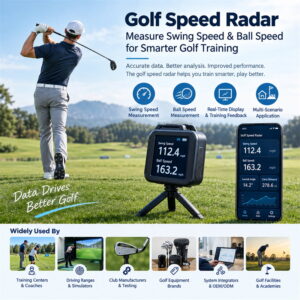
Many modern golf swing speed meters use radar technology to detect the movement of the golf club.
Radar-based measurement can offer several advantages:
- Fast detection
- Contact-free measurement
- Convenient setup
- Real-time feedback
- Suitable for repeated training
However, radar performance depends on the quality of the sensor, signal processing, algorithms, and product design.
This means two products that both claim to use radar technology may still provide very different user experiences.
For buyers, the key question is not simply:
“Does it use radar?”
Instead, ask:
“How stable and reliable is the radar measurement in real-world golf training?”
3. Response Speed
A good golf swing speed monitor should provide data quickly after the swing.
Slow response can interrupt the training rhythm.
For repeated practice, golfers generally want a simple cycle:
Swing → Measurement → Instant Feedback → Next Swing
Fast response is especially important for coaches and training facilities where multiple swings may be measured during a session.
4. Detection Range
Detection distance is another important consideration.
Different golf swing speed meters may have different recommended distances between the golfer and the device.
Before buying, check:
- Recommended setup distance
- Detection area
- Indoor performance
- Outdoor performance
- Whether the device needs to face a specific direction
Incorrect positioning can affect measurement performance even when the device itself is functioning correctly.
Always follow the manufacturer’s setup instructions.
5. Display and Visibility
A golf swing speed meter is often used outdoors, where direct sunlight can make small screens difficult to read.
A good display should be:
- Easy to read
- Bright enough for outdoor use
- Large enough for quick viewing
- Simple to operate
For beginners, a clear display can be more valuable than a complicated interface with too many numbers.
The most important information should be immediately visible after each swing.
6. Ease of Use
A common problem with golf training technology is unnecessary complexity.
Some devices require:
- Smartphone pairing
- Mobile applications
- Account registration
- Internet connections
- Multiple setup steps
These features can be useful for advanced users, but they are not always necessary.
For a beginner-friendly golf swing speed meter, look for:
Power on → Position the device → Swing → Read the result.
The simpler the basic operation, the easier it is to use consistently.
7. Portability
Golfers may use swing speed meters in different locations, including:
- Golf courses
- Driving ranges
- Indoor golf studios
- Home practice areas
- Coaching facilities
A compact and lightweight design makes the device easier to carry.
When evaluating portability, consider:
- Product size
- Weight
- Battery life
- Charging method
- Protective case
- Mounting options
For golfers who travel frequently, portability can be an important purchasing factor.
8. Battery Life
A golf swing speed meter is not very useful if the battery runs out during training.
Before purchasing, check the expected battery life and charging method.
USB charging is convenient for many users because the device can be recharged using common power sources.
For commercial training facilities, longer battery life can reduce interruptions during daily use.
Common Golf Swing Speed Meter Problems
Before buying a device, it is helpful to understand the most common problems users may encounter.
Problem 1: Inconsistent Readings
One of the biggest complaints about low-quality speed meters is inconsistent measurement.
For example:
Swing 1: 92 MPH
Swing 2: 101 MPH
Swing 3: 94 MPH
If the golfer’s swings are relatively similar, large variations may reduce confidence in the data.
Possible Causes
- Poor sensor quality
- Weak signal processing
- Incorrect device positioning
- Environmental interference
- Poor swing detection algorithms
What to Do
Choose a product with a proven measurement system and follow the recommended setup instructions.
Problem 2: Failure to Detect the Swing
Another common issue is that the device occasionally fails to recognize a swing.
This can happen when:
- The device is positioned incorrectly
- The golfer is outside the recommended detection area
- The swing speed is outside the supported range
- The sensor has difficulty tracking the club
A reliable golf swing speed meter should recognize normal golf swings consistently.
Problem 3: Difficult-to-Read Screen
A device may perform well technically but still provide a poor user experience if the display is difficult to read outdoors.
For outdoor golf training, screen visibility should not be overlooked.
Problem 4: Too Many Unnecessary Features
More features do not always mean a better product.
Some golfers only need accurate swing speed measurements.
If a product includes many complicated functions that the user never uses, it may increase cost without improving the training experience.
Choose features based on actual training needs.
Golf Swing Speed Meter Price Guide
Golf swing speed meters are available at different price points.
Entry-Level: Around $50
This segment is suitable for:
- Beginners
- Casual golfers
- Home users
- Budget-conscious buyers
The main priorities should be:
- Basic swing speed measurement
- Simple operation
- Acceptable accuracy
- Clear display
- Portable design
At this price level, don’t expect extensive advanced analytics.
Mid-Range: Around $100
The mid-range category can offer a better balance between price and performance.
Typical users include:
- Regular golfers
- Serious amateurs
- Golf coaches
- Training facilities
- Golf equipment brands
Important features may include:
- More stable measurements
- Better detection performance
- Improved display
- Longer battery life
- Better construction
- Additional training data
For many users, this category offers a strong balance between price, performance, and usability.
Premium golf swing speed measurement devices may include more advanced technologies and software features.
They may be suitable for:
- Professional coaches
- Golf academies
- Advanced players
- Professional training environments
- Performance-focused users
However, premium pricing does not automatically mean that every golfer needs a premium product.
The right choice depends on how the device will actually be used.
Golf Swing Speed Meter vs. Golf Launch Monitor
A common question is whether a golfer should buy a swing speed meter or a full launch monitor.
They are not exactly the same.
A golf swing speed meter primarily focuses on swing speed measurement and training feedback.
A golf launch monitor can measure a much wider range of golf performance data, depending on the product.
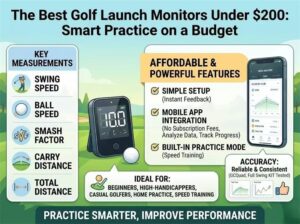
This may include:
- Club speed
- Ball speed
- Launch angle
- Carry distance
- Total distance
- Spin rate
- Smash factor
- Other shot data
If your primary goal is simply to measure swing speed, a dedicated golf swing speed meter may be more affordable and easier to use.
If you want comprehensive shot analysis, a launch monitor may be more appropriate.
How Beginners Should Choose a Golf Swing Speed Meter
If you are buying your first golf swing speed meter, don’t overcomplicate the decision.
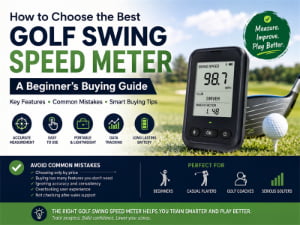
Focus on these five factors:
1. Accuracy
Does the device provide consistent readings?
2. Ease of Use
Can you start measuring without complicated setup?
3. Response Speed
Does it provide feedback quickly after the swing?
4. Display
Can you clearly see the result outdoors?
5. Value
Does the product provide the features you actually need for the price?
For most beginners, these factors are more important than having the longest feature list.
Golf Swing Speed Meter Buying Checklist
Before purchasing, ask the following questions:
- Is the swing speed measurement reliable?
- Does the device consistently detect normal swings?
- What is the recommended detection distance?
- Is the display easy to read outdoors?
- How quickly does it show results?
- How long does the battery last?
- Is the device portable?
- Is an app required?
- Is the operation beginner-friendly?
- Does the price match the actual features?
- Is there a warranty or after-sales service?
- Does the manufacturer provide technical support?
Answering these questions can help you avoid many common buying mistakes.
What Makes a Good Golf Swing Speed Meter?
A good golf swing speed meter does not necessarily need to have the most features.
Instead, it should deliver the fundamentals well:
Accurate Measurement + Stable Detection + Fast Response + Simple Operation + Good User Experience
For most golfers, these five factors create the foundation of a useful training device.
Manufacturers should also pay attention to hardware quality, sensor calibration, software algorithms, product durability, and quality control.
For Golf Brands and OEM Buyers
The growing demand for golf training technology has created opportunities for golf brands, distributors, Amazon sellers, and startups.
However, selecting the right golf swing speed meter OEM manufacturer is critical.
A low-cost supplier may offer an attractive initial price, but problems with measurement accuracy, product consistency, battery performance, or after-sales support can lead to:
- High return rates
- Negative reviews
- Customer complaints
- Higher warranty costs
- Poor brand reputation
When sourcing a golf swing speed meter, B2B buyers should evaluate more than the unit price.
- Sensor technology
- Measurement algorithm
- Production experience
- Quality control
- Product testing
- Certifications
- OEM/ODM capability
- Packaging customization
- Firmware development
- After-sales support
- Production capacity
A reliable factory should be able to provide clear product specifications, testing information, samples, and customization options.
Final Thoughts: How to Choose the Right Golf Swing Speed Meter
The best golf swing speed meter is not necessarily the most expensive model.
For beginners, focus on accuracy, consistency, simplicity, and value.
For regular golfers, look for better measurement stability, faster response, improved durability, and additional training features.
For coaches, golf facilities, distributors, and brands, reliability and long-term product support become even more important.
Before making a purchase, compare the device’s measurement performance, detection technology, usability, display, battery life, portability, price, and manufacturer support.
A well-designed golf swing speed meter can turn ordinary practice into measurable training and help golfers better understand their swing performance.
If you are looking for a reliable golf swing speed meter for your golf brand, distribution business, or private-label project, working directly with an experienced OEM manufacturer can help you develop a product that balances performance, cost, and market requirements.