Meta Title: How to Choose a Golf Swing Speed Meter: Beginner’s Buying Guide
Meta Description: Looking for the best golf swing speed meter? Learn what beginners should check before buying, including accuracy, speed measurement, ease of use, portability, data tracking, and common mistakes to avoid.
Primary Keyword: golf swing speed meter
Secondary Keywords: golf swing speed monitor, golf swing speed analyzer, golf speed meter, golf swing analyzer for beginners, best golf swing speed meter, golf training device, swing speed measurement
Introduction
If you want to hit the golf ball farther, one of the first numbers you should understand is your swing speed.
A golf swing speed meter can help you measure clubhead speed and track your progress during practice. Instead of relying on feel alone, golfers can use measurable data to understand whether their swing is becoming faster and more consistent.
However, choosing the right golf swing speed meter is not always easy.
There are many devices on the market with different sensors, measurement methods, apps, displays, and price points. Some provide only basic swing speed data, while others offer additional metrics such as ball speed, tempo, carry distance, or swing analysis.
For beginners, buying the most expensive device is not necessarily the best solution.
The better approach is to choose a device that is accurate, easy to use, portable, and suitable for your training goals.
This guide explains what to look for when buying a golf swing speed meter and the common mistakes beginners should avoid.
What Is a Golf Swing Speed Meter?
A golf swing speed meter is a training device designed to measure the speed of a golf swing, typically focusing on clubhead speed.
Depending on the technology used, some golf swing speed monitors can also provide additional information such as:
- Clubhead speed
- Ball speed
- Swing tempo
- Smash factor
- Estimated distance
- Swing consistency
- Practice history
Modern golf training devices are increasingly designed to make performance data easier for everyday golfers to access. Portable monitors and swing analyzers can now provide useful feedback without requiring professional-level equipment.
For beginners, the most important function is simple:
Can the device provide consistent and easy-to-understand feedback?
Why Should Beginners Use a Golf Swing Speed Meter?
Many beginners make the same mistake: they try to swing harder because they want more distance.
But swinging harder does not automatically mean swinging better.
A golf swing speed meter provides objective feedback that can help golfers understand their current performance and track improvement over time.
1. Understand Your Current Swing Speed
Before trying to increase swing speed, you need to know your starting point.
Recording your baseline speed allows you to compare your results after several weeks of practice.
2. Track Progress
Golf improvement takes time.
A speed monitor allows you to record your numbers instead of relying on memory or feeling.
For example:
Week 1: 82 mph
Week 4: 85 mph
Week 8: 88 mph
The numbers provide a simple way to see whether your training is producing measurable results.
3. Improve Training Efficiency
Instead of hitting hundreds of balls without feedback, golfers can use speed data to structure their practice sessions.
This can make training more focused and measurable.
4. Avoid Overtraining
More speed is not always better.
If a golfer increases swing speed but loses balance, contact quality, or consistency, the extra speed may not translate into better results.
A good golf swing speed monitor should therefore be used as a training feedback tool, not simply a device for chasing the highest number.
7 Things to Check Before Buying a Golf Swing Speed Meter
1. Measurement Accuracy
Accuracy should be your first priority.
If the measurement is inconsistent, it becomes difficult to know whether your swing is actually improving.
Do not focus only on the maximum speed advertised by the manufacturer.
Instead, look for information about:
- Measurement accuracy
- Repeatability
- Sensor technology
- Testing conditions
- Calibration
- Measurement range
A device that produces consistent results is generally more useful for training than one that occasionally shows an impressive number.
Beginner Tip
Do not ask only:
“How fast can it measure?”
Also ask:
“How consistently can it measure?”
2. Ease of Use
A golf training device should not require a complicated setup every time you practice.
This is especially important for beginners.
Look for features such as:
- Simple controls
- Quick startup
- Easy-to-read display
- Minimal calibration
- Clear measurement results
- Simple data management
Some advanced golf swing analyzers provide extensive data, but too much information can overwhelm a new golfer.
For beginners, simple and actionable feedback is often more valuable than dozens of complicated metrics.
3. Portability
Golfers practice in different environments:
- Driving ranges
- Golf courses
- Home practice areas
- Indoor training spaces
- Golf simulators
A compact and lightweight golf swing speed meter is easier to carry and use regularly.
Portability can also make a significant difference in how often a golfer actually uses the device.
A product that stays in a golf bag is more useful than a sophisticated device that is inconvenient to set up.
4. Display and Data Visibility
Golf practice often takes place outdoors under strong sunlight.
A speed meter should provide information that is easy to read quickly.
Important factors include:
- Screen visibility
- Font size
- Display contrast
- Measurement response speed
- Simple user interface
If the golfer has to stop practicing to understand the screen, the device becomes less convenient.
5. What Data Does It Measure?
Not every golfer needs the same data.
A beginner may only need:
Clubhead Speed + Basic Feedback
A more experienced golfer may want:
Clubhead Speed + Ball Speed + Smash Factor + Tempo + Distance
Advanced swing analyzers may provide even more detailed information, including swing mechanics and additional performance metrics.
Before buying, decide which data you will actually use.
A simple rule:
Do not pay for data you do not understand or use.
6. Battery Life and Connectivity
If the device uses a rechargeable battery, check its expected operating time.
For Bluetooth or app-connected products, also consider:
- Smartphone compatibility
- Bluetooth stability
- App usability
- Data synchronization
- Firmware updates
- Whether a subscription is required
Subscription costs can significantly affect the long-term cost of some golf technology products, so beginners should check the total ownership cost before buying.
7. Price vs. Actual Value
The most expensive golf swing speed meter is not automatically the best choice.
Today’s golf technology market includes simple portable devices as well as advanced launch monitors and swing analyzers. The right product depends on the golfer’s goals, budget, and required data.
A useful way to think about the market is:
Entry Level
Best for:
- Beginners
- Casual golfers
- Basic swing-speed training
- Budget-conscious buyers
Priority:
Easy operation + reliable measurement + affordable price
Mid-Range
Best for:
- Regular golfers
- Serious practice
- Golf coaches
- Players tracking long-term progress
Priority:
Accuracy + multiple metrics + data tracking
Advanced
Best for:
- Professional coaching
- Club fitting
- Golf academies
- Serious performance analysis
Priority:
Detailed data + advanced analytics + software integration
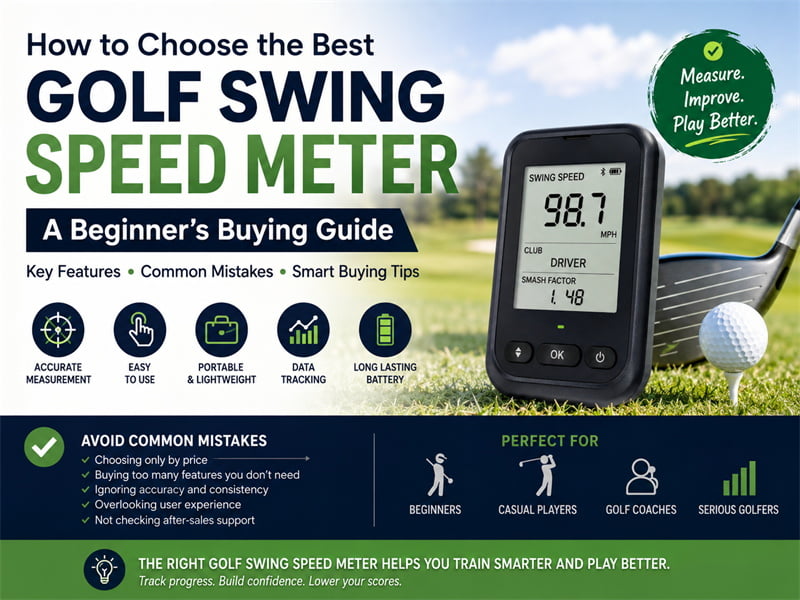
5 Common Mistakes Beginners Should Avoid
Mistake 1: Choosing the Cheapest Device
Low price can be attractive, but extremely cheap devices may sacrifice measurement consistency, build quality, display performance, or software support.
The goal should not be to find the cheapest golf speed meter.
The goal is to find the best value for your training needs.
Mistake 2: Buying Too Many Features
More features do not automatically mean better training.
If you are a beginner and only want to track swing speed, you may not need a professional-level launch monitor with dozens of metrics.
Start with the information you can actually use.
Mistake 3: Focusing Only on Maximum Swing Speed
Trying to beat your previous speed every session can encourage golfers to swing harder rather than better.
Instead, track:
- Average swing speed
- Consistency
- Ball contact
- Tempo
- Distance
- Overall swing quality
The goal is not simply to produce one extremely fast swing.
The goal is to develop repeatable speed that produces better shots.
Mistake 4: Ignoring the User Experience
A technically impressive device can still be a poor product if it is difficult to use.
Before buying, consider:
Can I set it up quickly?
Can I read the results easily?
Can I understand the data?
Will I actually use it every week?
These questions are often more important for beginners than advanced specifications.
Mistake 5: Not Checking After-Sales Support
Golf technology is not only about hardware.
For electronic products, buyers should also consider:
- Warranty
- Customer support
- Firmware updates
- App support
- Replacement parts
- Battery service
A reliable manufacturer and clear after-sales policy can make a significant difference to the long-term ownership experience.
Golf Swing Speed Meter Buying Checklist
Before purchasing, use this simple checklist:
| Feature | What to Look For |
| Accuracy | Consistent and repeatable measurements |
| Operation | Simple controls |
| Display | Easy to read outdoors |
| Portability | Compact and lightweight |
| Battery | Reliable battery life |
| Data | Metrics relevant to your goals |
| Connectivity | Stable Bluetooth/app connection if required |
| Durability | Suitable for regular golf practice |
| Warranty | Clear warranty and support |
| Price | Good value rather than simply low price |
If a product meets most of these requirements, it is likely to be a better choice than a device selected purely by price or the number of advertised features.
What Is the Best Golf Swing Speed Meter for a Beginner?
There is no single best golf swing speed meter for every golfer.
The best choice depends on your training goals.
If you are a complete beginner, prioritize:
Simple operation + accurate speed measurement + clear display + affordable price.
If you practice regularly, consider:
Speed + ball data + progress tracking + app connectivity.
If you are a coach, advanced player, or club fitter, you may need:
More detailed swing and ball-flight data + advanced analytics + professional software.
The key is to buy according to your actual needs rather than choosing the device with the longest feature list.
Final Thoughts
A golf swing speed meter can be a useful training tool for golfers who want to replace guesswork with measurable feedback.
For beginners, however, choosing the right device is more important than choosing the most advanced device.
Before buying, focus on the fundamentals:
Accuracy.
Consistency.
Ease of use.
Portability.
Useful data.
Reliable support.
Good overall value.
Avoid paying for features you will never use, and do not judge a golf speed meter only by its maximum measurement range or advertised specifications.
The best golf swing speed monitor is the one that gives you reliable feedback and helps you train consistently.
Looking for a Reliable Golf Swing Speed Meter Manufacturer?
For golf brands, distributors, retailers, and private-label businesses, product quality starts with the manufacturing process.
A reliable OEM golf swing speed meter manufacturer should be able to provide:
- Stable measurement performance
- Consistent production quality
- Professional product testing
- OEM/ODM customization
- Firmware and software support
- Reliable quality control
- Competitive bulk pricing
- Stable global supply
If you are developing your own golf swing speed meter, golf swing speed monitor, or golf training device, choosing the right manufacturing partner can help reduce product risks and improve long-term customer satisfaction.
Contact us to discuss OEM/ODM golf swing speed meter solutions for your brand.