As golf and smart training technology continue to evolve, a growing number of players, coaches, driving ranges, and indoor simulator operators are turning to data-driven training. As a key piece of golf measurement equipment, the golf speed radar provides reliable data on swing speed, ball speed, and other critical metrics — supporting technical analysis, training optimization, and equipment testing.
Whether used for daily practice, professional performance analysis, or integration with golf simulators and related systems, choosing the right golf speed measurement device helps improve training efficiency and data analysis capabilities.
What Is a Golf Speed Radar?
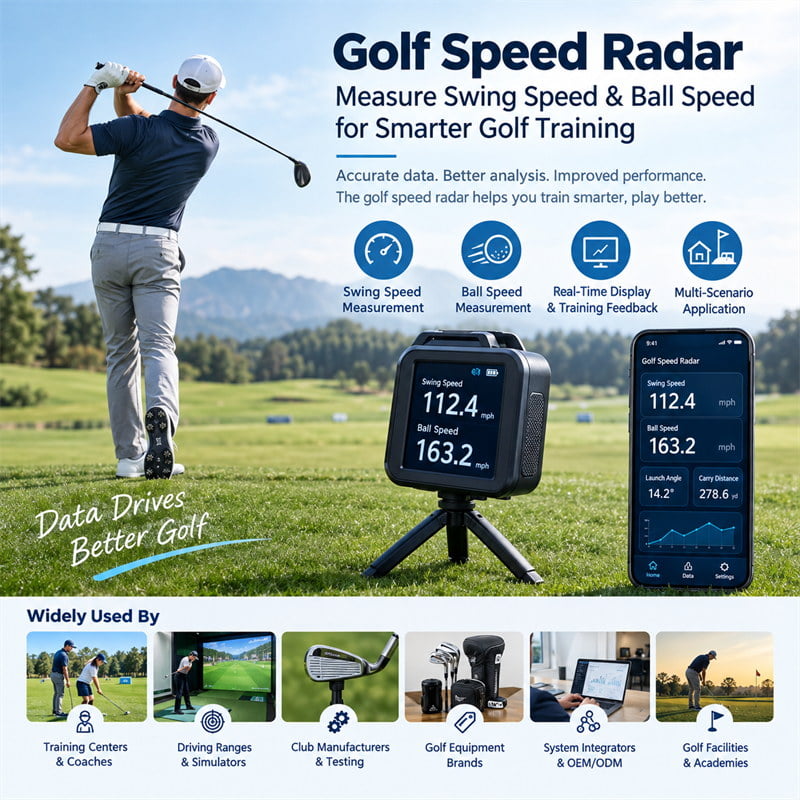
A golf speed radar is a professional device designed to measure speed-related parameters in golf, primarily club head (swing) speed and golf ball speed, with select models supporting additional data collection and analysis.
Depending on the product design and technology, golf speed radars employ radar sensors, optical camera systems, or other motion detection technologies to track and analyze targets. Results can be viewed on the device’s built-in display, through a mobile app, or via companion software.
Compared with relying on the naked eye or personal experience, a golf speed radar delivers objective, quantifiable data that helps users understand how different swing techniques, club configurations, and training methods affect performance.
For golf equipment brands, professional training institutions, simulator manufacturers, and equipment buyers, golf speed radars are also a key component of intelligent golf training solutions.
Core Features of a Golf Speed Radar
1. Swing Speed Measurement
Swing speed is one of the most important indicators of a player’s swing performance. A golf swing speed radar helps users track club head speed, and repeated measurements allow comparison of data across different swing styles.
In daily training, players can record swing speeds for different clubs, monitor changes over time, and combine technical adjustments with shot results to build more effective training plans.
For coaches and training centers, consistent, easy-to-read speed data also improves the efficiency of feedback during lessons.
2. Ball Speed Measurement
Ball speed is a major factor in shot distance. A golf ball speed measuring device detects the speed of the ball immediately after it leaves the clubface, providing data support for analyzing strike efficiency and distance performance.
By comparing ball speed under different impact conditions, users can better evaluate their striking performance and further refine club selection, contact position, and swing technique.
Note that swing speed and ball speed are two distinct metrics. When purchasing, confirm whether a device supports both measurement functions.
3. Real-Time Display and Training Feedback
Golf speed radars with real-time display present results immediately after each shot, helping users understand their performance on the spot.
Some models also offer data logging, historical result review, wireless connectivity, or software analysis — suitable for individuals and professional organizations that need continuous performance tracking.
Feature sets vary by model; always refer to official specifications and real-world test results.
4. Multi-Scenario Speed Measurement
Depending on measurement range and technical design, golf speed radars can be used in indoor training facilities, outdoor driving ranges, golf simulators, club testing, and sports equipment R&D.
Choosing a device suited to your environment helps improve measurement efficiency and reduces the impact of installation position, available space, or environmental factors on results.
Who Uses Golf Speed Radars?
Golf Training Centers and Coaching Institutions
Professional training centers rely on objective data to support instruction. Golf speed radars can record players’ swing or ball speeds, helping coaches compare performance before and after training and create personalized development plans.
Driving Ranges and Indoor Simulators
In driving range and simulator environments, speed measurement devices supply velocity data to the training system. For projects that require integration with simulator software, display terminals, or other sensors, confirm the device’s communication interfaces and software compatibility in advance.
Golf Club Manufacturing and Testing
In club R&D, product evaluation, and custom fitting, speed data helps compare performance across different club configurations. Combined with other impact parameters, it provides a reference for club design and product testing.
Golf Equipment Brands and System Integrators
For equipment brands, OEM/ODM manufacturers, and system integrators, golf speed radars can be sold as standalone products or integrated into larger measurement and training systems.
For bulk purchases or custom development, carefully evaluate measurement performance, hardware interfaces, structural design, software compatibility, and long-term supply capability.
How to Choose the Right Golf Speed Radar
Golf speed radars on the market differ in measurement functions, technology, and positioning. Consider the following factors when selecting a device.
1. Define Your Measurement Parameters
First, confirm whether the device will primarily measure swing speed, ball speed, or multiple metrics at once. For users focused on basic speed data, a dedicated, function-specific radar may be more appropriate; for professional training or simulator projects, consider devices with more comprehensive data capture.
2. Evaluate Accuracy and Repeatability
Accuracy and repeatability are key indicators of a golf speed radar’s quality. Review the measurement range, stated error, test conditions, and validated results — rather than relying solely on marketing claims.
3. Choose the Right Sensing Technology
Radar-based technology suits a wide range of speed-detection scenarios; optical measurement systems can provide motion imagery and related parameter analysis depending on system design. Different technologies have different application conditions — evaluate based on target distance, installation method, ambient lighting, and measurement needs.
4. Consider Installation and Operation
Portable devices suit individual training and mobile testing, while fixed units may be better for long-term deployment or system integration. Before purchasing, confirm installation requirements, power supply, operating procedures, and environmental limitations.
5. Check Data Output and System Compatibility
For commercial applications and integration projects, data interfaces and software compatibility are especially important. Confirm in advance whether the device supports the display methods, communication protocols, data export options, or third-party software integration you need.
6. Assess Total Cost and Service Capability
Enterprise procurement should look beyond unit price to consider product stability, technical support, warranty policy, delivery lead times, and long-term supply. For bulk orders, also explore OEM/ODM customization, industrial design, branding, and feature development services.
Why Choose a Professional Golf Speed Radar Supplier?
For business customers, the right golf speed radar must meet measurement needs and fit the actual use environment and business scenario.
When evaluating suppliers, focus on the following:
- Product performance: clear technical specifications, measurement range, and error documentation
- Application fit: solutions suited to individual training, commercial training facilities, or system integration
- System integration: data interfaces, software compatibility, and custom development capabilities by model
- Quality management: product testing processes, quality control measures, and relevant certifications
- Procurement support: sample testing, volume supply, after-sales service, and technical support
- Customization: OEM/ODM cooperation and feature customization for special requirements
Working with a supplier that provides complete technical documentation and a solid service system reduces the communication cost of product selection and project integration.
The Future of Golf Speed Radars
Driven by smart sensors, data analytics, and sports technology, golf speed radars are becoming more portable, intelligent, and multi-functional.
Future devices are expected to further integrate swing speed, ball speed, shot-performance analysis, and training records, while wireless connectivity and software platforms improve data management efficiency.
For manufacturers and system integrators, sensing technology, data interfaces, software compatibility, and customization capability will be key drivers of product development and market competitiveness.
At the same time, more features do not mean every radar suits every scenario. Businesses and individual users should still choose devices based on actual needs, budget, and technical specifications.
Conclusion: Choose the Right Golf Speed Radar — Make Training Data-Driven
Golf speed radars provide essential data support for golf training, club testing, and smart sports equipment. By measuring swing speed or ball speed, users gain a more objective understanding of performance and can optimize training and testing processes alongside other technical parameters.
Whether you are a golf enthusiast, a professional coach, a training center operator, or a golf equipment manufacturer and buyer, defining your measurement needs, evaluating product performance, and selecting the right technology are key steps to getting real value from your equipment.
Looking for the right golf speed radar? Contact us today to learn about product specifications, application solutions, sample testing, and bulk procurement services. We’ll help you select the right golf speed measurement solution based on your actual application needs.